


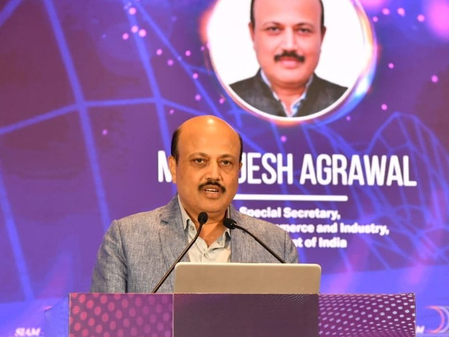
New Delhi, Oct 9 (IANS): Commerce Secretary Rajesh Agrawal said established rules are being questioned as sustainability‑linked trade measures and digital trade reshape the global agenda, and called for rigorous legal thinking to meet the challenge, an official statement said on Friday.
The statement from the Ministry of Commerce & Industry said Agrawal at the 9th Anniversary Celebration of the Centre for Trade and Investment Law (CTIL) congratulated it for successfully earning the trust of government, industry and the trade law community.
He recalled CTIL’s contributions to the Department of Commerce through legal analysis and specialised support in free trade agreement negotiations, dispute settlement and institutional memory building.
“India needs institutions like CTIL that do more than follow developments in international economic law and are capable of shaping them,” said Justice P. S. Narasimha, Judge, Supreme Court of India.
Justice Narasimha observed that international investment law has evolved from an initial focus on the protection of foreign investment towards greater recognition of the regulatory freedom of States.
He noted that the field is now entering a phase in which questions of institutionalisation, legitimacy and the long-term balance between investment and public power have assumed greater significance. He underscored the need for a durable international investment law framework that balances investment protection with the regulatory authority of States.
The ministry cited experts saying CTIL has provided over 4,000 legal opinions, participated in negotiations on nearly 10 free trade agreements and contributed to WTO negotiations, submissions, notifications and dispute settlement.
Additional Secretary, Ministry of Commerce and Industry, Yashvir Singh highlighted CTIL’s contributions to India’s major trade engagements, including support for major free trade agreements and engagements such as the G20 and BRICS over the past several years.
He also highlighted CTIL’s work in WTO negotiations, notifications and dispute settlement, along with its contributions to India’s economic diplomacy and the development of human capital in international economic law.