

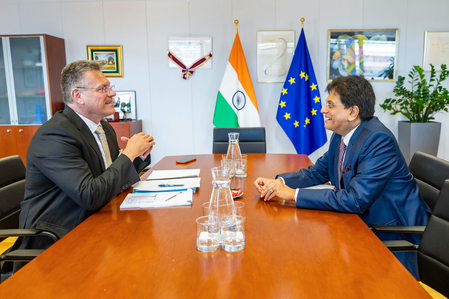
New Delhi, Oct 8 (IANS): The India-EU trade deal constitutes the first major bilateral trade agreement between two of the world’s largest economic entities and is expected to see a sharp rise in trade between the two sides, according to a new report.
At the same time, the trade deal only partially liberalises sensitive sectors like agriculture, excludes government procurement, and leaves many non-tariff barriers in place. In some areas like the automobile sector, tariff reductions will be phased in over a period of 10 years.
“This apparent gap between political ambition and limited liberalisation should not simply be understood as a shortcoming of the trade deal. Rather, the nature of the agreement illustrates a defining feature of the emerging EU-India relationship,” the article by researcher Tobias Scholz states.
Unlike many of Europe’s traditional partnerships, the EU’s approach to India is driven by a strategic partnership that both sides increasingly pursue out of necessity. At a time when major international disruptions put Europe’s and India’s economic models under pressure, both actors recognise a growing need to diversify trade relations, reduce geo-economic risks, and cultivate new partnerships, the article observes.
It points that the dramatic change in the geopolitical landscape after Donald Trump took over as US President and the Russia-Ukraine war and China’s muscle flexing in the Indo-Pacific region have forced the EU to look at India as a new strategic partner.
“Until recently, Europe relied on its security partnership with the United States, the Chinese export market, and cheap fossil energy imports from Russia. Within a few years, all three dependencies turned into liabilities. An emerging threat perception toward China provided the initial EU-India momentum.
“The EU’s joint communication on China in 2019 prominently labelled Beijing as a partner, competitor, and rival; the subsequent Indo-Pacific Strategy emphasised the importance of the EU’s relations with New Delhi,” the article states.
It also highlights that India has increasingly seen a convergence of interests with Europe after the country experienced the first deadly border clashes with China in decades in the Ladakh sector. Yet, India also realised an economic opportunity in positioning itself as a China+1 partner for European countries.